
 SEARCH
 LIST YOUR PROPERTY
Rent controls in Summer 2026: A turning point for the property market
Summer 2026 marks a crucial milestone in the French property landscape. With the ongoing housing crisis in many cities, public authorities have decided to take a tougher stance to protect tenants' purchasing power while regulating the market. At Roomlala, we support thousands of hosts and tenants every day with their homestay and shared housing arrangements. We understand how legislation can sometimes seem complex, or even daunting, for a host simply wanting to earn an income from an empty room, or for a student tenant looking for an affordable place to live. That is why we have broken down the very latest legal changes regarding rent control, a system that is expanding significantly this year.
First and foremost, it is essential to understand what we are talking about. Rent control is a measure that sets a maximum ceiling per square metre for rents in properties let unfurnished or furnished as a primary residence or via a mobility lease. It is fundamental not to confuse this mechanism with the limitation on rent increases when re-letting, or with the annual revision based on the Rent Reference Index (IRL). Control acts as an absolute shield: regardless of the property's history, the rent excluding charges cannot mathematically exceed a certain threshold, known as the increased reference rent. This threshold corresponds to the median rent in the geographical area, plus 20%, and is updated annually by prefectural decree.
See also: 2026 Housing Act: What changes for room rentals in Spain, Shared housing in Wallonia 2026: Domiciliation and cohabitant status and Shared housing in Ontario: How the rental law exemption is encouraging hosts in 2026
For hosts and tenants, this regulation requires constant vigilance. A landlord who ignores these rules risks severe penalties, while an ill-informed tenant could pay hundreds of extra euros each year. At Roomlala, our mission is to offer you a secure and transparent environment. In this article, we will explore in detail the new high-demand areas applying this system from Summer 2026, the direct and often misunderstood impact of these rules on shared housing, and the best practices for renting with complete peace of mind and in full compliance with the law.
The 3DS Law and the crucial deadline of 23 November 2026
To fully grasp the stakes of this summer 2026, we must look for a moment at the legislation. Rent control, as we know it today, is technically an experiment. Introduced by the ELAN Law, this mechanism was extended and regulated by the Law on Differentiation, Decentralisation, Deconcentration and various measures for the simplification of local public action, better known as the 3DS Law. This legislation set a very specific deadline: the experiment is in force until 23 November 2026. On this date, if no new legislative extension is voted on by Parliament, the system will come to an end.
This date of 23 November 2026 creates a particularly intense transition period. The municipalities that have recently received authorisation to apply rent control must act quickly to implement their prefectural decrees and local rent observatories. For landlords, this means adapting quickly to new rules that could, theoretically, disappear or be made permanent at the end of the year. At Roomlala, we advise you to always work on the principle that the rule in force at the time of signing the lease applies, and never to bet on a potential future cancellation of the law to justify an excessive rent.
It is also important to note that this law imposes total transparency. The rental lease must include the reference rent and the increased reference rent applicable to the property. If these details are missing, the tenant is entitled to serve the landlord with a formal notice to add them, and can even request a rent reduction if the latter exceeds the legal ceiling. This is a powerful protection that requires landlords to be perfectly informed of the amounts applicable in their street or neighbourhood.
New urban areas under rent control in Summer 2026
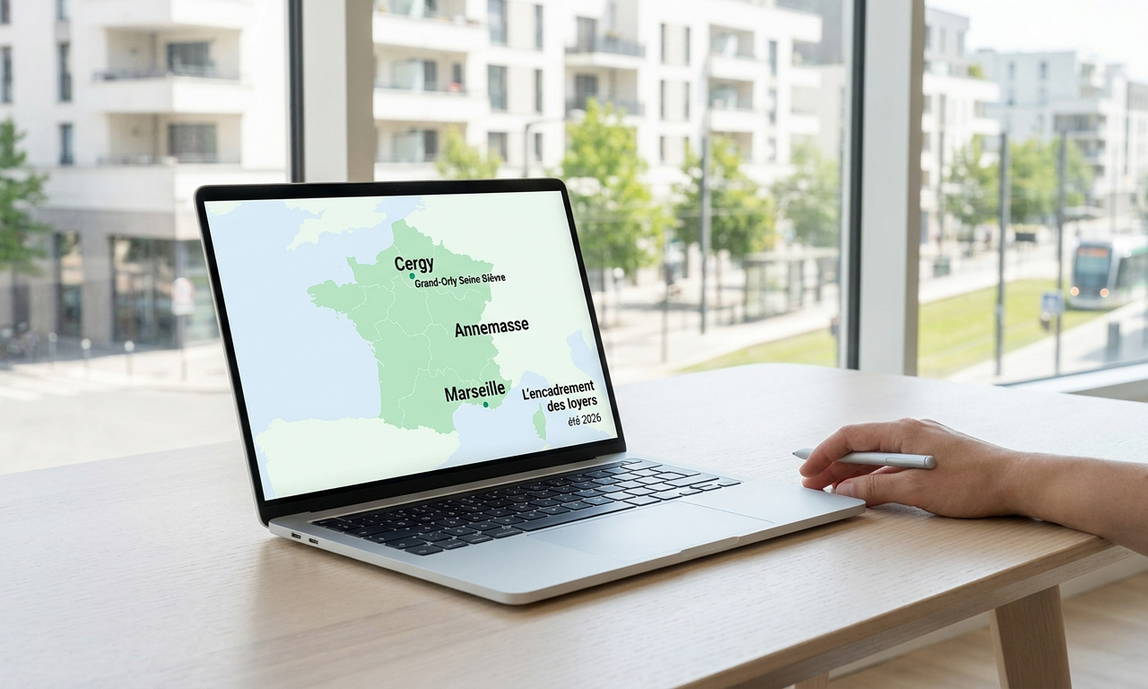
Until now, rent control was mainly associated with Paris, Lille, Lyon, Villeurbanne, Montpellier, Bordeaux and some municipalities in the Paris region such as those of Est Ensemble or Plaine Commune. But in Summer 2026, the rent control map is expanding significantly. New urban areas are joining the scheme to respond to a surge in property prices that is stifling the middle class and students. Among these new entrants, we find very varied geographical sectors, demonstrating that housing tension is no longer the sole preserve of the capital.
Here are the main urban areas applying or actively preparing to apply rent control for this summer 2026:
- Marseille: The Phocaean city, which has seen its rents explode in recent years due to its growing attractiveness and the proliferation of short-term tourist rentals, is introducing a strict cap, particularly in its central and coastal districts.
- Annemasse Agglo: Located on the French-Swiss border, this area is bearing the full brunt of the pressure on the purchasing power of cross-border workers. Here, the control aims to allow local workers to continue to afford accommodation in their area.
- Cergy: A major student hub in the Île-de-France region, Cergy is adopting the system to protect its large university population against abuse, particularly in the small-surface and shared housing sector.
- Grand-Orly Seine Bièvre: This vast territory in the Paris region is joining other territorial public establishments (EPT) in the Paris suburbs to harmonise rent regulation at the gates of Paris.
For landlords located in these new zones, it is no longer the time for approximation. The exact entry into force dates and the precise breakdown of geographical sectors vary according to local prefectural decrees. An apartment located on one side of a street may have a different reference rent from one located on the pavement opposite. It is therefore imperative to consult the local simulators set up by the prefectures or to contact the National Housing Information Agency (ANIL) to obtain the exact amount applicable to your property.
The direct impact of rent control on shared housing and homestays
Shared housing and homestays are extremely popular accommodation solutions on Roomlala. They allow for social connection, shared expenses, and the optimisation of available space. However, a persistent misconception suggests that renting by the room allows one to bypass rent control by multiplying small leases. This is completely false. The legislator has provided for very strict rules to ensure that shared housing does not become a legal loophole allowing landlords to escape the cap.
The golden rule is simple but relentless: for shared housing, the total sum of rents paid by all tenants cannot in any case exceed the legal ceiling applicable to the entire property. In other words, if you own an 80 m² apartment with an increased reference rent of 1,200 euros, you cannot rent out four rooms at 400 euros each (which would be 1,600 euros in total). The cumulative amount of rent excluding charges received by the landlord must strictly remain less than or equal to 1,200 euros. This rule applies strictly, whether the property is let unfurnished or furnished.
At Roomlala, we ensure our users fully understand this mechanism to avoid any disputes. As a landlord, you must calculate the total living area of your property, determine the maximum rent authorised for this overall surface, and then divide this amount among the different tenants. This division does not necessarily have to be equal: it can be done on a pro-rata basis according to the size of each person's private room. The essential thing is that the final total respects the legal framework.
The case of the single shared lease
Under a single lease, all tenants sign the same rental contract. They are generally linked by a solidarity clause, which means they are jointly responsible for paying the entire rent. In this configuration, the application of rent control is relatively simple to verify. The overall rent indicated on the single lease is compared directly to the increased reference rent calculated for the total surface area of the apartment or house.
Let's take a concrete example in Cergy, a new area concerned in Summer 2026. You are renting a 75 m² furnished apartment to three students via a single lease. The prefectural decree sets the increased reference rent for this type of property, in this specific neighbourhood, at 18 euros per square metre. The legal ceiling for your apartment is therefore 1,350 euros (75 x 18). The overall rent entered on the single lease cannot exceed 1,350 euros excluding charges. If the students decide to divide this rent into three parts of 450 euros, that is their internal choice, but as far as the law is concerned, it is the total amount of the lease that counts and that respects the cap.
It is important to specify that rental charges (water, electricity, maintenance of common areas, internet) are not included in this cap. They must be invoiced separately, either at actual cost with an annual adjustment, or as a fixed charge (very common in furnished shared housing). However, the fixed charge must not be clearly disproportionate to the actual costs, or it risks being reclassified by a judge as a disguised rent supplement.
The case of individual room leases
The situation becomes a little more complex, but just as regulated, when the landlord chooses to sign individual leases with each tenant. This practice is very common for homestays on Roomlala, because it offers more flexibility: each tenant is independent, there is no solidarity clause, and departures or arrivals are managed individually. Each contract covers the exclusive enjoyment of a specific room and the shared use of common rooms (kitchen, living room, bathroom).
However, the law is formal: the sum of the rents of all individual leases in progress for the same property must not exceed the cap applicable to the whole property. If we take our example of the 75 m² apartment in Cergy with an overall ceiling of 1,350 euros. The landlord rents three rooms of different sizes. They could set the rent for the large room at 500 euros, the medium one at 450 euros, and the small one at 400 euros. The sum is 1,350 euros; the cap is respected.
A major point of vigilance for hosts: if you rent a single room in your own primary residence (classic homestay), the rent for this room must theoretically respect the cap calculated on the surface of the rented room, increased by a share of the common areas. This is a calculation that can prove tedious. We highly recommend using the ANIL simulators to assess the weighted surface area and determine the fair and legal rent for the room you are offering on Roomlala.
The rent supplement: A strictly regulated exception
Faced with the rigour of rent control, the law has provided a safety valve: the rent supplement. This mechanism allows a landlord to set a rent higher than the increased reference rent. However, beware of false beliefs! This supplement is absolutely not an automatic right and it is subject to extremely strict conditions, which are increasingly being checked by the authorities and challenged by tenants.
For a rent supplement to be legal, the property must present objectively exceptional location or comfort characteristics. These characteristics must meet several cumulative criteria: they must not have already been taken into account for the determination of the reference rent (which already takes into account the construction period, the number of rooms, and the type of unfurnished/furnished rental), they must be decisive for setting the rent compared to properties in the same category in the same geographical sector, and they must not give rise to recovery as charges.
It is vital to understand what does NOT justify a rent supplement. A newly refurbished kitchen, the installation of fibre optic internet, the presence of a simple balcony facing the street, good quality furniture, or double exposure are considered normal elements of comfort or are already valued by the conventional market. Furthermore, since the 2022 purchasing power law, it is formally forbidden to apply a rent supplement if the property has certain defects: sanitary facilities on the landing, signs of damp, windows letting in air, lack of adequate heating, or if it is classified as a thermal sieve (DPE F or G).
So, what really justifies a supplement? Let's take valid concrete examples. An apartment in Marseille with a huge 40 m² private terrace offering a panoramic, unobstructed view of the Old Port and the Notre-Dame de la Garde basilica possesses an exceptional location characteristic. A property equipped with extraordinary luxury fittings, such as an integrated private sauna or a large private garden in the heart of a very dense area like Grand-Orly Seine Bièvre, can also justify such a supplement. If you apply a supplement, its amount and precise justification must appear in the lease, and the tenant has three months to challenge it.
Landlords and tenants: Your obligations, your rights, and sanctions
Non-compliance with rent control is no longer taken lightly by public authorities. Municipalities that join the scheme in Summer 2026, such as Annemasse or Cergy, are setting up dedicated teams to spot illegal listings and handle tenant reports. At Roomlala, we are keen to inform our hosts of the risks involved, because our goal is to promote trusted, sustainable, and law-abiding accommodation.
Landlords who exceed the legal ceiling without valid justification (or with a rent supplement deemed abusive) expose themselves to very deterrent financial sanctions. If an infringement is noted, the prefect serves the landlord a formal notice to bring the lease into compliance within two months and to reimburse the overpayment to the tenant. If the landlord refuses to comply, they are liable to an administrative fine of up to 5,000 euros for an individual and up to 15,000 euros for a legal entity (such as a property investment company). Furthermore, the tenant can take legal action to obtain a rent reduction and the retroactive reimbursement of sums paid in excess, and this for the entire duration of the lease.
For tenants, including those in shared housing or homestays, the challenge process has been simplified. If you notice that your rent exceeds the legal ceiling applicable in your city, you can contact the Departmental Conciliation Commission (CDC) free of charge. This joint body will attempt to find an amicable agreement with the landlord to lower the rent. In the event of conciliation failure, the protection dispute judge can be seized. It is therefore essential for tenants to check the reference rent amount as soon as they start looking for accommodation, using official tools.
In conclusion, the expansion of rent control in Summer 2026 is an unavoidable reality that is profoundly changing rental practices in many new urban areas. Whether you are a landlord acting in good faith or a student joining a shared home in Marseille or Cergy, information is your best ally. At Roomlala, we strongly encourage you to consult official sites such as that of ANIL or the public service to learn about the prefectural decrees in your sector. By respecting these rules, you not only guarantee the legality of your lease, but you also contribute to a fairer and more transparent housing market, values that are at the heart of the Roomlala spirit.






There are no comments yet.
Add a comment
You must log in to post a comment.