
 SEARCH
 LIST YOUR PROPERTY
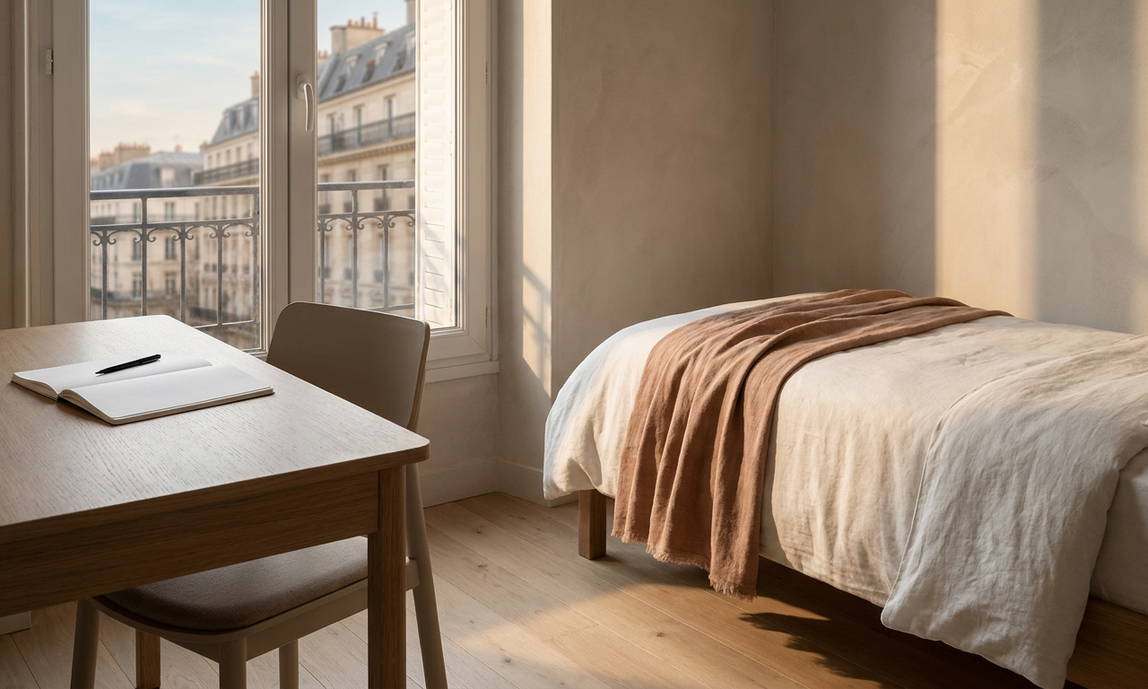
The start of the academic year is often synonymous with stress for thousands of young people, but the year 2026 marks a particularly critical turning point. While the future of 2026 rent controls is the subject of lively debates in Parliament, the search for student accommodation in France is increasingly resembling an uphill battle. At Roomlala, we observe with concern the skyrocketing prices in the traditional rental market, exacerbated by the sometimes questionable practices of certain landlords. Faced with abusive student rents that have become common for small living spaces, it is urgent to rethink the way we find housing. It is in this tense context that homestays and student shared housing are emerging not only as anti-inflation refuges, but also as humane and legal solutions, offering a reassuring environment for both tenants and hosts. An analysis of a high-tension back-to-school period and the alternatives for finding accommodation with peace of mind.
2026 Rent control: The alarming situation for student housing in France
The rent control mechanism, derived from the ELAN law, is going through a period of unprecedented turbulence. Theoretically scheduled to expire on 23 November 2026, this experimental mechanism was supposed to regulate the market in high-demand areas. However, the reality on the ground is quite different. As the new academic year approaches, students and their families are encountering a saturated rental market where the rules seem less and less respected, creating a climate of major financial insecurity for young people.
See also: Housing crisis: Renting a room to an apprentice, the 2026 supportive solution in French-speaking Switzerland, Shared housing in Wallonia 2026: Domiciliation and cohabitant status and LMNP reform and 2026 DPE rules: Why renting out a homestay is becoming a sanctuary for hosts
A damning study published by the association Que Choisir Ensemble on 7 July 2026 sheds light on the scale of the phenomenon. According to this report, no less than 95% of student housing listings in six major cities subject to rent control do not comply with the legal caps. This staggering figure demonstrates that the price shield supposed to protect the most precarious tenants is, in practice, widely bypassed in the traditional private rental market.
The financial impact on students is colossal. The study reveals that the average excess demanded by landlords for very small spaces, particularly studios of less than 18 square metres, reaches 234 euros per month. Over a full academic year, this represents an additional burden of more than 2000 euros, a sum that most scholarship recipients or young workers simply cannot afford without sacrificing other essential needs such as food or health.
Politically, uncertainty reigns. In early July 2026, the Minister of Housing publicly declared himself in favour of a two-year extension of the scheme for cities already affected. This intention must be translated into a bill that will be fiercely debated in the Senate at the start of the academic year. While waiting for a possible parliamentary validation, this period of legal ambiguity unfortunately encourages some market players to anticipate the end of rent control by artificially inflating their prices this summer.
Student rent and abuse: Why are small spaces the most affected?
Pressure of demand in the face of dwindling supply
The student housing market in France suffers from a deep structural imbalance. Each year, the number of students increases, while the construction of new university residences or social housing struggles to keep pace. This shortage concentrates demand on the private sector, and more particularly on studios and small attic rooms, creating fierce competition between rental candidates.
It is precisely on these small surfaces that abusive student rent crystallises. To circumvent the 2026 rent control caps, many landlords make abusive use of the rent supplement mechanism. Initially intended to reward exceptional features (such as a view of a historical monument or luxury amenities), this supplement is today being misused. A simple washing machine, a tiny balcony or a basic renovation serve as a pretext to demand astronomical sums, in total contradiction with the spirit of the law.
Students are a particularly vulnerable target for these excesses. Often pressed for time, anxious at the idea of finding themselves on the street a few days before the start of the academic year, they accept illegal conditions out of despair. Furthermore, a lack of knowledge about their rights and the fear of seeing their application rejected in favour of another candidate discourage them from challenging these abusive surcharges before the conciliation commission.
Let's take a concrete example frequently encountered this year: Lucas, a master's student in Paris, visited a 15-square-metre studio in the 11th arrondissement. While the maximum reference rent set the cap at around 600 euros, the listing displayed 850 euros, justifying this difference with the presence of a wall-mounted television and a microwave. Faced with the shortage, Lucas almost signed, before discovering the safer alternatives offered by homestays.
The uncertain future of the law and its direct consequences
The 23 November 2026 deadline, the theoretical end date of the ELAN law experiment, acts like a guillotine on the property market. If the extension desired by the government is not voted on by Parliament, the cities currently subject to rent control could slide into total deregulation. This prospect deeply worries tenant defence associations, who fear a brutal price correction.
The debates scheduled in the Senate in the autumn promise to be heated. On one hand, supporters of rent control point to the abuses revealed by Que Choisir and demand harsher sanctions against fraudulent landlords. On the other, some landlord representatives believe that price constraints discourage rental investment and worsen the housing shortage. In the middle of this political tug-of-war, the student is held hostage.
This situation demonstrates the limits of a housing policy based solely on repressive constraint, especially when monitoring is insufficient. It is becoming imperative to turn to structural solutions that naturally promote price moderation. This is where the sharing economy and habitat sharing take on their full meaning, by reconciling the interests of landlords and tenants.
At Roomlala, we are convinced that transparency and trust are the best bulwarks against inflation. By connecting individuals with a spare room directly with students looking for accommodation, we bypass the pitfalls of the traditional rental market to propose an economic model that is healthier, fairer and deeply humane.
Homestays: A transparent and regulated alternative
A model that naturally favours moderate rents
Faced with exploding prices, the homestay stands out as an obvious choice. This type of accommodation involves a host or a main tenant renting a furnished room in their primary residence to a third party. Unlike independent studios, which are heavily subject to speculation, the homestay benefits from a virtuous financial dynamic that encourages price moderation.
One of the major levers for this moderation is the tax benefit granted to hosts. Until 31 December 2026, the General Tax Code provides for a total exemption from income tax for rents received, under one strict condition: the rent must be set within reasonable limits defined each year by the tax authorities. For the year 2026, these caps strongly encourage hosts to offer attractive rates, well below market prices, in order to benefit from this highly advantageous tax niche.
This fiscal mechanism acts as a natural anti-abuse shield. It is in the landlord's best interest to respect the caps so as not to have their rental income heavily taxed. For their part, the student gains access to comfortable accommodation, often better located and more spacious than an overpriced studio, for a controlled budget. It is a win-win relationship that restores purchasing power to young people while supplementing household income.
Let's imagine the case of Sylvie, a retiree living in Bordeaux. She has a 14-square-metre room that she rents via Roomlala for 380 euros per month, bills included. By respecting the tax cap, she pays no tax on this income. On the same street, a studio of equivalent size is rented for 650 euros by a private investor, often in breach of rent controls. The choice for a student is easy to make.
Roomlala's position on regulatory complexity
The strict application of rent control to homestays raises many legal debates. The main difficulty lies in the calculation of the living area: how to assess the share of common areas (kitchen, bathroom, living room) that the tenant has access to? This ambiguity makes the application of the ELAN law caps complex for rooms integrated into the host's home.
However, at Roomlala, our position has always been clear and protective. Although the case law is still unclear on this specific point, we have historically recommended that all our hosts located in high-demand areas comply with the principles of rent control. We provide them with estimation tools and personalised advice to help them set a fair, ethical price that meets the expectations of the student market.
Beyond strict legality, it is the very philosophy of our platform that guarantees the safety of students. The hosts who register on Roomlala are generally not investors seeking maximum profitability at all costs. They are families, retirees or young professionals looking for extra income, but also for company, cultural exchange or mutual help in everyday life. This human dimension naturally discourages abusive practices.
Finally, booking via our platform offers a secure framework. Profiles are verified, payments are secure and reviews left by previous tenants guarantee the transparency of listings. If a rent seems clearly disproportionate to us, our moderation teams intervene. In a context where 95% of traditional listings are unlawful, this proactive moderation is a guarantee of invaluable peace of mind when preparing for the 2026 academic year.
Student shared housing and long-term cohabitation: The other anti-inflation shields
In addition to the traditional homestay, long-term student shared housing is emerging as another robust response to the housing crisis. Faced with the impossibility of renting a decent studio alone without being subjected to abusive student rent, grouping together allows costs to be diluted. Within the framework of 2026 rent control, shared housing leases (whether single or multiple) are also subject to the caps, offering additional legal protection to tenants.
Shared housing allows not only for the rent to be split, but also for all the fixed costs that weigh heavily on the student budget to be shared: internet subscriptions, electricity bills, home insurance and even grocery shopping. At Roomlala, we facilitate connections for the creation of supportive shared housing arrangements, where common spaces become places for living and mutual aid, considerably reducing the isolation often felt during the first year of studies away from the family home.
It is also worth highlighting the rise of intergenerational cohabitation, a specific form of homestay. This model offers a very moderate rent, or even total free accommodation, in exchange for minor services provided to an elderly person (presence in the evening, help with shopping, sharing meals). It is a deeply social solution that addresses both student precariousness and the isolation of seniors, while completely freeing itself from the speculative excesses of the traditional property market.
In conclusion, faced with the alarming findings reported by consumer associations and the political uncertainties surrounding rent control for the end of 2026, it is vital to explore new paths. Student housing in France must no longer be a source of anxiety or debt. By choosing homestays or shared housing via trusted platforms like Roomlala, students ensure themselves a serene start to the academic year, a warm living environment and a controlled budget, far from the abuses of a system that is running out of steam. Do not wait for Senate decisions to secure your future: explore our verified listings today and find your ideal host.



There are no comments yet.
Add a comment
You must log in to post a comment.