
 SEARCH
 LIST YOUR PROPERTY
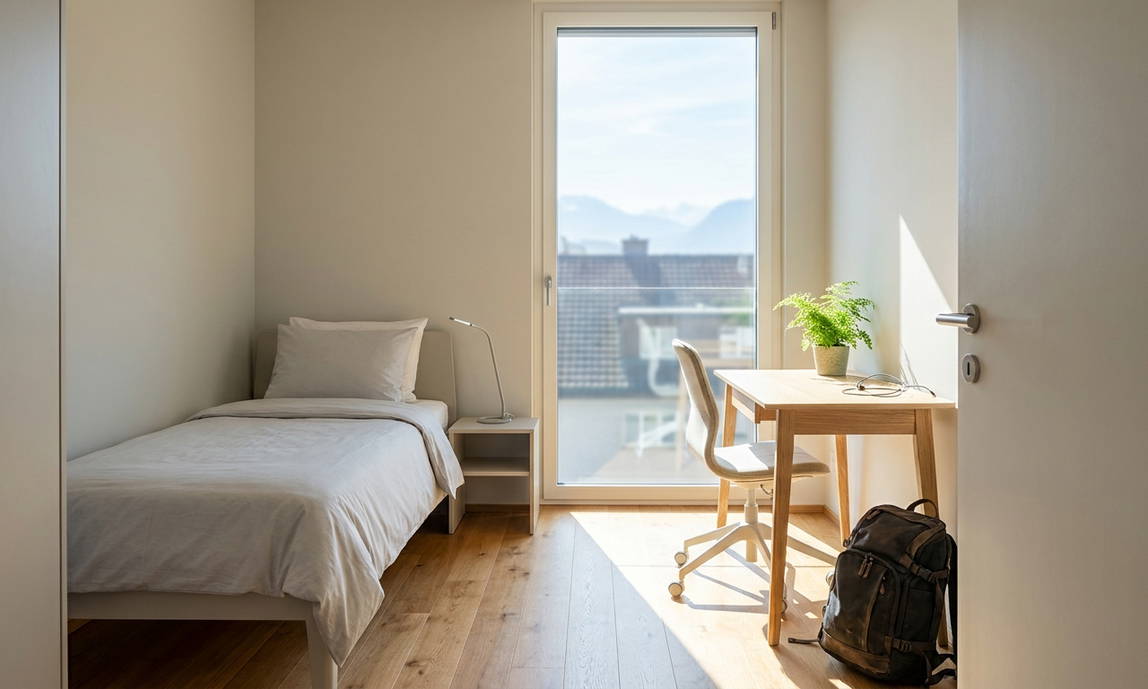
The September 2026 academic year is shaping up to be a real obstacle course for thousands of students and young professionals. With vacancy rates reaching historically low levels in major university cities, finding a place to live is becoming a feat. At Roomlala, we are observing growing anxiety over this Swiss housing shortage, which is hitting the new generation head-on. Faced with skyrocketing rents and an almost non-existent supply of studios, more and more young people are turning to more human and affordable alternatives. In this tense context, long-term homestays are emerging not as a plan B, but as the pragmatic and community-focused solution par excellence. Here is an analysis of an unprecedented crisis and the solutions available to you for the 2026 academic year.
The critical state of the property market: The housing shortage in Switzerland in 2026
The figures published in June 2026 by cantonal statistical offices are stark and confirm a rapid deterioration of the property market in urban centres. It is important to note that this crisis does not affect the entire Swiss territory uniformly. Peripheral municipalities and rural areas retain a certain degree of liquidity, but major university hubs are concentrating all the tension. This hyper-concentration of demand creates a major imbalance that new constructions are struggling to bridge.
See also: Lille Braderie 2026: A guide to last-minute homestays, Neuchâtel Wine Festival 2026: Budget-friendly homestays and Fête de l'Humanité 2026: The tip for low-cost accommodation near Base 217
Alarming statistics in large university cities
In Geneva, the situation has become particularly critical. The vacancy rate fell to 0.31% in June 2026, marking its lowest level since 2011. Across the whole canton, there are only 793 homes available—a drop in the ocean compared to the constant influx of new residents and international students. Finding student housing in Geneva in 2026 is therefore akin to a quest for the Holy Grail, requiring months of forward planning and impeccable applications.
The situation is equally worrying in the canton of Vaud, where the vacancy rate stands at 0.87%. Although slightly higher than in Geneva, this figure remains dramatically below the 1.5% equilibrium threshold set by property experts. UNIL and EPFL students often find themselves forced to extend their searches well beyond the Lausanne area, significantly increasing their daily commute times.
Finally, the Zurich metropolis has not been spared. With a vacancy rate stagnating around 0.48% in 2026, the Swiss economic capital remains one of the most expensive and inaccessible cities in Europe for young people. The pressure on small properties is such that even young professionals with comfortable salaries are struggling to find housing, pushing students towards increasingly precarious solutions.
A two-tier market and the decline of shared housing
The current crisis has highlighted a very distinct two-tier market phenomenon. On one hand, tenants who have been settled for several years benefit from relatively moderate rents thanks to old leases. On the other, new entrants to the market face prohibitive rents as soon as a property is put back up for rent. This dichotomy directly penalises young people who, by definition, are looking to sign new contracts.
At the same time, we are witnessing a drastic slowdown in the creation of new shared housing. Traditionally, students would group together to rent large apartments. However, the scarcity of 3 to 5-room family apartments on the current market prevents these groups from forming. Families are keeping their large homes for longer, and the few large apartments that do hit the market reach discouraging prices. Finding shared housing in Zurich or Geneva in a classic apartment has become a near-impossible mission for a group of students without wealthy Swiss guarantors.
It is precisely this paralysis of the traditional market that is pushing rental applicants to rethink their housing arrangements. Faced with the impossibility of creating new independent shared housing, moving into an already established home is becoming the most logical and reassuring path.
Homestays: A pragmatic and human alternative
Faced with this gloomy outlook, renting a room in a homestay stands out as the obvious choice. This model, long perceived as being reserved for short stays or foreign students on language immersion programmes, has become widely democratised. At Roomlala, we are seeing a spectacular increase in both supply and demand for this type of accommodation, which perfectly meets the challenges of 2026.
Undeniable economic advantages for both parties
In a context of inflation and continuously rising costs, renting a room in a homestay provides a financial breath of fresh air. For students or young professionals, it is the assurance of a controlled rent, often 30% to 50% lower than the price of an independent studio on the open market. Furthermore, bills (water, electricity, internet) are generally included in the price, avoiding nasty surprises at the end of the month.
Let's take a concrete example: a student room in Lausanne in a homestay currently goes for around 600 to 800 CHF per month, all bills included. In comparison, a 20-square-metre studio in the same area easily exceeds 1200 CHF, not counting energy bills and various subscriptions. For a student budget, this difference is monumental and allows one to focus on studies rather than on exhausting part-time jobs.
For the host, whether an owner or a main tenant, renting out an unoccupied room allows them to generate a significant supplementary income. This financial boost helps to cope with the rising cost of living and health insurance premiums, while making the most of unused space. It is a win-win economic model that fits perfectly into the era of the collaborative economy.
A community-focused approach against isolation
Beyond the purely financial aspect, long-term homestays take on a fundamental human dimension. The housing crisis is often accompanied by a social crisis, where young people find themselves isolated in tiny, peripheral dwellings. Living in a homestay means recreating social ties. For a young person arriving in a new city, it is an opportunity to have a point of reference, advice on the neighbourhoods, or simply someone to talk to at the end of the day.
This intergenerational solidarity is particularly valuable. We see many seniors with large family homes that became empty after their children moved out choosing to host students. This provides them with a reassuring presence, a retirement supplement, and new energy in their daily lives. It is a direct response to the isolation of the elderly and student precariousness.
At Roomlala, we make it a point of honour to facilitate these meetings based on trust and mutual respect. Detailed profiles and reviews left by previous tenants make it possible to ensure that everyone's expectations are aligned, thus guaranteeing a harmonious and enriching cohabitation.
The Swiss legal framework: What you need to know before starting
While renting a room in a homestay is an excellent solution, it must not be done at the expense of legal rules. Switzerland has a precise legal framework regarding renting and subletting. At Roomlala, we support our users so that every contract is drawn up properly, thus ensuring the safety of both the tenant and the host.
Subletting: The golden rules for main tenants
It is crucial to understand that if you are a tenant of your home yourself, you have the right to sublet a room, but under certain strict conditions set out by the Swiss Code of Obligations (art. 262 CO). The absolute rule is to obtain the prior consent of your landlord or management agency. This consent can only be refused for valid reasons, for example, if you refuse to communicate the terms of the sublet or if the latter presents major inconveniences for the owner.
The second fundamental point of vigilance concerns the price. Swiss law formally prohibits making an abusive profit at the expense of the subtenant. The rent requested for the room must be proportional to the total rent of the apartment, taking into account the surface area occupied, access to common areas, and a possible supplement for furnishings (generally estimated at between 10% and 20%).
Here is a clear use case: if you rent a 4-room apartment for 2000 CHF per month and you sublet a furnished room representing 25% of the total surface area, you cannot charge 1200 CHF for this room. The rent should be between 500 and 600 CHF, including bills and furniture depreciation. Failure to comply with this rule can lead to the termination of your own lease.
Safety and peace of mind with Roomlala
Whether you are an owner or a main tenant, drawing up a written contract is essential, even for a rental of just a few months. This document must clearly state the amount of rent, the sharing of bills, the rules of common life, and notice conditions. The notice period for a furnished room is generally short, offering appreciable flexibility for both parties.
At Roomlala, we secure the entire process. Payments are made online in a secure manner, which avoids disputes related to unpaid rent or non-returned security deposits. Furthermore, our platform allows you to filter profiles and verify identities, establishing a climate of trust from the very first contact. We also provide contract templates adapted to Swiss legislation to simplify your life.
By respecting these simple rules, homestays become a serene experience. It allows you to avoid the stress of group viewings where dozens of applicants fight over the same studio, favouring a direct approach that is more respectful and human.
Practical tips for a successful search or hosting experience in 2026
To successfully navigate this ultra-tense property market, it is necessary to adopt the right strategies. Whether you are looking for a room for the academic year or you are planning to become a host, here are our expert tips to maximise your chances of success.
Strategies for students and young professionals searching
The first rule is anticipation, but also an open mind. Do not just focus on the hyper-centre. Swiss public transport networks (SBB, trams, buses) are among the most efficient in the world. Broaden your search to peripheral municipalities. For example, looking in Renens, Prilly, or Écublens rather than central Lausanne, or exploring Lancy and Vernier instead of central Geneva, will significantly increase your options while reducing your budget.
Next, polish your profile on Roomlala. Treat it as a real tenant CV. Include a smiling photo, describe your lifestyle habits (are you quiet, studious, an early riser?), your passions, and what you are looking for in a cohabitation. Hosts are very sensitive to interpersonal skills. A personalised message explaining why you want to live with that specific person will always have more impact than a generic request.
- Prepare your application: Always have a copy of your ID, a certificate from the university or an employment contract, and if possible, references from previous landlords at your disposal.
- Be transparent: If you return late at weekends or if you have any allergies, specify this from the start to avoid misunderstandings.
- Offer service swaps: Sometimes, a rent reduction can be negotiated in exchange for babysitting, homework help, or gardening.
Tips for potential hosts
If you have a spare room, now is the ideal time to get started. Start by preparing the space: the room must be clean, cleared of your superfluous personal belongings, and equipped with the essentials (a good bed, a desk, storage, and a quality Wi-Fi connection, which is essential for students). A welcoming and neutral room will allow the tenant to easily picture themselves there.
Set a fair and attractive price. Find out about the prices charged in your neighbourhood on Roomlala. A reasonable price will guarantee that you receive many requests, leaving you with the choice of the candidate who best matches your lifestyle. Do not hesitate to set clear house rules from the very first meeting (use of the kitchen, washing machine times, hosting guests) to lay healthy foundations.
Finally, prioritise communication. The key to successful cohabitation lies in dialogue. Organise a video call or an in-person meeting before validating the booking. Ask questions about the candidate's lifestyle. By hosting a student or a young worker, you are not just renting out square metres; you are actively participating in solving the housing crisis in Switzerland while having an enriching human experience.









There are no comments yet.
Add a comment
You must log in to post a comment.