
 SEARCH
 LIST YOUR PROPERTY
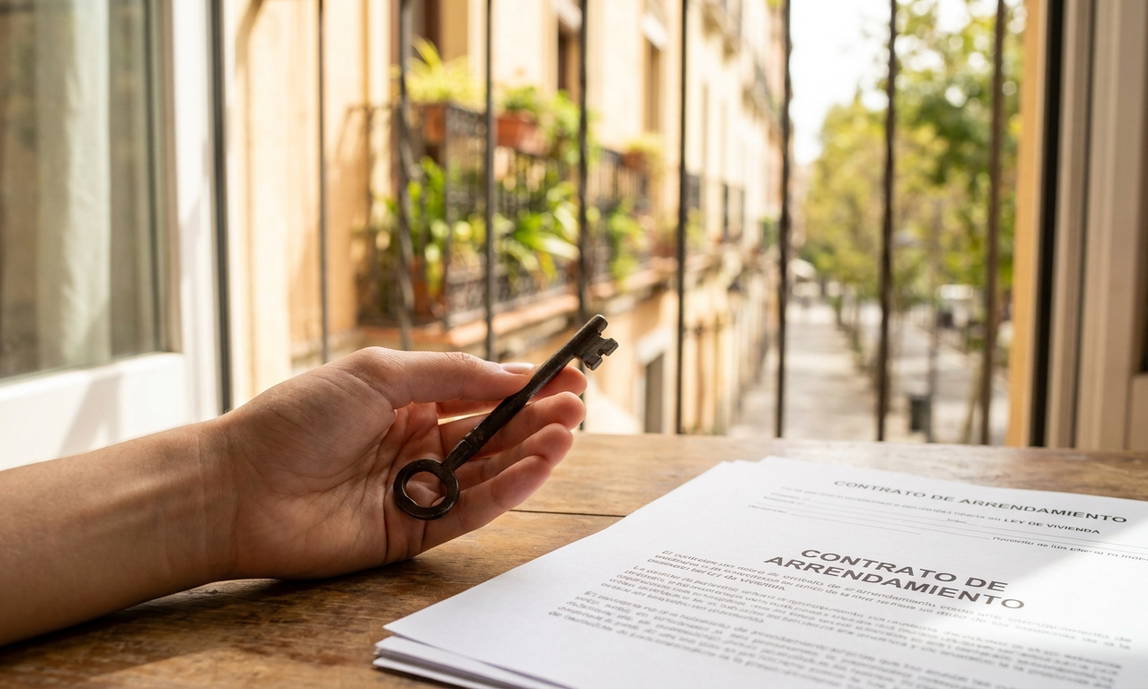
The 2026 Spanish Housing Law: an unprecedented shake-up for students
Finding a roof over your head for the start of the academic year in September is often an uphill battle, but this year, the situation has reached new heights. The reason? The strict implementation and repercussions of the now-famous 2026 Spanish Housing Law. Originally designed to protect tenants by capping rents for entire homes in so-called "stressed" areas, this legislation has triggered an unexpected butterfly effect on the property market. At Roomlala, we see the challenges you face every day, and we are here to help you decipher this new reality.
In practical terms, faced with restrictions imposed on standard leases, many landlords have made the radical choice to withdraw their properties from the traditional rental market. The supply of entire apartments has literally collapsed in the lead-up to the start of the 2026 academic year. This shortage exacerbates already fierce competition: according to recent data published by the Idealista portal, a listing for a standard apartment in Barcelona can generate up to 99 contacts in just a few hours. This is unbearable pressure for a student simply looking to settle in for their studies.
See also: Porta 65 Jovem programme in 2026: How to fund your room in a shared housing arrangement in Portugal, Student lease vs. standard furnished lease: Which option should you choose for renting your room for the 2026 academic year? and 2026 student intake in Brussels: Everything you need to know about student leases and shared housing
It is in this ultra-strained context that the search for student accommodation in Madrid or Barcelona has been transformed. Given the impossibility of renting a studio or a one-bedroom apartment at an affordable price, students are turning en masse to alternatives. Shared housing and homestays (the well-known habitaciones) are no longer just social or economic lifestyle choices; they have become the preferred—if not essential—solution for finding legal accommodation in Spain.
Why such enthusiasm for renting a room? Historically, renting an individual room fell under the Spanish Civil Code (Código Civil) and not the Urban Lease Act (LAU) which governs entire apartments. This legal subtlety allowed landlords to set room prices freely, thus escaping the caps of the Housing Law (Ley de Vivienda). Although this freedom is currently being regulated in 2026, this dynamic has profoundly reshaped the rental supply, pushing students toward new ways of living together.
Room rentals and shared housing: The new student refuge
Why homestays are so appealing
Faced with the scarcity of apartments, renting a room in Spain for the academic year is emerging as a lifeline for students. At Roomlala, we are seeing an explosion in demand for this type of accommodation. The primary advantage remains financial, even if room rents have experienced high inflation. Today, you should expect to pay on average between 500 and 600 euros per month for a room in Spain's large university cities. Although this budget is significant, it remains well below the cost of an entire apartment, not to mention agency fees and deposits, which are often inaccessible to young people.
Beyond the economic aspect, a homestay offers valuable flexibility. Contracts are often more flexible, adapted to the academic year, and generally include utilities (water, electricity, internet), which avoids unpleasant surprises at the end of the month. For landlords, it is also a reassuring formula that allows them to maintain control of their home while generating additional income, all within a legal framework secured by platforms like ours.
Take the concrete example of Maria, a French Erasmus student at the Complutense University of Madrid for the start of the 2026 academic year. After two months of fruitless searches for a studio, faced with endless waiting lists, she opted for a homestay via Roomlala. Not only did she find a place to live in less than a week in the Moncloa district for 550 euros including utilities, but she is also benefiting from linguistic immersion and advice from her Madrid-based host to help her integrate quickly.
The Housing Law and shared housing: what changes in 2026
It is crucial to fully understand the nuances of the Housing Law for shared housing in 2026, as the legal landscape is evolving rapidly. The Spanish government has become aware of the legal loophole that was pushing landlords toward room rentals to bypass rent caps. In response, 2026 marks the rollout of a mandatory national register for professional room landlords. This register aims to bring transparency and combat abuses in the student market.
It is also fundamental not to confuse alquiler de temporada (temporary rental) and alquiler de habitaciones (room rental). While both statuses are popular with students, they are subject to separate reforms. Temporary rentals, often used for stays of a few months, are increasingly regulated to prove the tenant's genuine temporary need (such as a specific university course). As for room rentals, they are the subject of intense national debate, aiming to result in a law to regulate these specific rents across the entire country.
While waiting for this comprehensive national law, the market remains fragmented. In cities like Madrid or Valencia, room prices currently remain free, governed by supply and demand under the auspices of the Civil Code. This explains the rapid rise in room rents in the capital, where landlords are anticipating future regulations while taking advantage of the current high student demand. This is why we advise you to secure your accommodation as early as possible.
The Catalan exception: Strict capping since 1 January 2026
While Madrid is still navigating a relatively free market for rooms, the situation is radically different in Catalonia. Since 1 January 2026, the region has been strictly applying Law 11/2025 on housing. This pioneering legislation in Spain aims to definitively close the Civil Code's legal loophole by directly targeting the prices of shared housing and individual rooms.
The rule established by this Catalan law is clear and mathematical: the sum of the rents for all rooms in a single home can no longer exceed the price cap that would be applied to the entire apartment if it were rented under a standard LAU lease. In other words, a Barcelona landlord can no longer divide their apartment into four rooms to multiply their profits beyond the legal limit imposed in their stressed area.
This measure has an immediate impact on student accommodation in Madrid or Barcelona, creating a two-speed market. In Barcelona, students are seeing a stabilisation, or even a slight drop, in room prices compared to the previous year. However, this strict regulation also has the perverse effect of discouraging some landlords, further reducing the overall supply available on the Catalan market. Competition there therefore remains dauntingly intense.
Let’s illustrate this with the case of Carlos, a master’s student at the University of Barcelona. While visiting a three-bedroom apartment in the Gràcia district, he was able to verify on the Generalitat's official register that the total rent for the apartment was capped at 1200 euros. Thanks to Law 11/2025, the landlord had to adjust the price of each room to 400 euros, guaranteeing Carlos a fair and legal rate. At Roomlala, we make sure to inform our hosts and tenants of these regional specifics to guarantee smooth transactions.
Our advice for successfully renting a room in Spain for the 2026 academic year
Anticipate and diversify your searches
Faced with the complexity of the 2026 Spanish Housing Law and the shortage of supply, anticipation is your best weapon. Don't wait until the end of August to start your search. As soon as your admission is confirmed in the spring, start scanning listings. At Roomlala, we recommend creating alerts and contacting hosts several months in advance, because the best rooms—especially those in homestays that offer excellent value for money—are gone in just a few days.
Our second piece of advice is to show geographical flexibility. Don't limit yourself to hyper-centres or neighbourhoods immediately adjacent to your university. Spain's public transport networks (metro, cercanías, bus) are extremely well-developed and reliable. Expanding your search area to peripheral residential neighbourhoods will allow you to find more spacious rooms, often at lower prices, and hosts who are delighted to welcome international students.
Here are some good practices to adopt:
- Prepare a solid application: Always have your documents ready in digital format (ID, proof of university enrolment, financial guarantees).
- Personalise your messages: Hosts receive many requests. A clear, polite introductory message explaining your study project and lifestyle will make all the difference.
- Use secure platforms: Use websites like Roomlala to avoid the frequent scams on social media and ensure the security of your payments.
Understand your rental contract
Once you've found the perfect place, stay vigilant when it comes time to sign. It is imperative to know under which legal regime you are signing. Ask your landlord clearly if the contract is governed by the Civil Code (standard room contract) or if it falls under the framework of an alquiler de temporada. Rights and notice periods differ considerably between these two statuses.
Be particularly careful about how utilities are split. With the rising cost of energy, more and more landlords prefer to rent the room with a fixed utility allowance or, conversely, to split actual bills between flatmates. Ensure that the conditions are explicitly written in the contract to avoid any disputes in the middle of winter. Also, check the house rules, especially if you are living in a homestay.
Finally, if you are renting in Catalonia, do not hesitate to find out the price cap for the apartment to ensure that your room rent complies with the new Law 11/2025. At Roomlala, we are committed to supporting our community by providing clear contract templates and verifying our users' profiles, so that your only concern for this 2026 academic year is the success of your exams in Spain.


There are no comments yet.
Add a comment
You must log in to post a comment.