
 SEARCH
 LIST YOUR PROPERTY
Inflation continues to weigh heavily on Canadian household budgets, and property owners are not spared. Between rising interest rates, increasing property taxes, and the growing cost of maintenance, balancing your budget is becoming a real challenge. It is within this tense context that the government's long-awaited announcement regarding the 2027 BC rent increase comes into play. At Roomlala, we know how crucial it is for you, as hosts, to find viable solutions to make your property profitable while staying within the legal framework.
The news is out: the rent cap for 2027 in British Columbia has been officially set. While this measure aims to protect tenants against excessive hikes, it significantly limits the room for manoeuvre for landlords. Fortunately, there are strategic alternatives for generating extra income without running into the same restrictions. Renting out a room in your home is now emerging as one of the best ways to counter inflation.
See also: Ontario rent increase 2026: Why renting out a room appeals to hosts, Rent controls in 2026: What are the new rules for shared housing? and New subletting rules in Switzerland: How to rent a room legally in 2026
In this comprehensive article, we will break down the new provincial guidelines for you, explain in detail how this new cap applies, and demonstrate why renting out a spare room in your primary residence could well be the financial breath of fresh air you need for 2027.
Decoding: Everything you need to know about the 2027 BC rent increase
The new official cap set at 2.2%
The British Columbia government has decided: the legal rent increase cap for the year 2027 is set at 2.2%. This figure marks a very slight decrease compared to the previous year, when the cap was set at 2.3% for 2026. At Roomlala, we observe that this decision is part of a provincial effort to stabilise the real estate market while taking consumer price indices into account. For landlords, this means that rental income from current leases can only grow very moderately.
It is essential to understand that this 2.2% rate represents the maximum legal limit. A landlord cannot, under any circumstances, impose an increase higher than this percentage for a standard residential lease subject to the Residential Tenancy Act. This strict limitation forces many landlords to rethink their profitability strategy, as a 2.2% increase rarely covers the actual rise in fixed costs related to the property, such as insurance, repairs, or utilities.
This new cap applies exclusively to rent increases that take effect on or after 1 January 2027. If you are planning an increase for late 2026, the old rate (2.3%) remains in effect. It is therefore crucial to plan your rental schedule carefully so as not to end up in violation of provincial law and risk having your request invalidated.
Application rules and the mandatory notice period
Regulations in British Columbia are extremely strict regarding the rent increase procedure. To be in full compliance with the law, a landlord must meet several cumulative criteria:
- The 12-month rule: Rent increases are allowed only once per 12-month period for the same tenant. It is strictly forbidden to split this increase or apply it prematurely.
- The notice period: The landlord must provide three full months of notice. For example, a notification sent before 30 September 2026 is required for an increase applicable on 1 January 2027.
- The official form: Any notification of an increase for a lease governed by the act must be made via the form approved by the province, otherwise the procedure is absolutely null and void.
A major point of caution: notification cannot be done via a simple informal email, text message, or handwritten letter. Using any document other than the official Notice of Rent Increase will lead to the pure and simple invalidity of the increase, forcing the landlord to restart the procedure from scratch and lose months of adjusted income. At Roomlala, we recommend that you always download the most recent version of the form from the official BC Housing website.
British Columbia rental regulations and different types of accommodation
The case of independent secondary suites
The British Columbia rental regulations apply uniformly to all housing considered as independent residential units. This naturally includes apartments and entire homes, but also what are commonly referred to as secondary suites (or basement suites). If you rent out the basement of your home and it has its own kitchen, bathroom, and separate entrance, the tenant is fully protected by the Residential Tenancy Act.
In this configuration, the lease you sign is a standard residential lease. Consequently, future annual rent increases will inevitably be subject to the 2.2% legal cap for 2027. You will have to follow the three-month notice procedure to the letter and use the official form. There are no exceptions to this rule for independent suites, even if they are physically located within your primary residence.
Take the example of a landlord in Victoria who rents their finished basement for $1,500 per month. With the 2027 cap, the maximum authorised increase will be only $33 per month. Facing inflation that drives electricity and water bills up much more significantly, this landlord could end up with a real shortfall. This is why it is essential to explore other ways of optimising the space available within the property itself.
Sharing a kitchen or bathroom: A major exception
This is where the legislation offers particularly interesting flexibility for landlords. If the tenant of the room shares the kitchen or bathroom with the landlord (you), the rental does not fall under the British Columbia Residential Tenancy Act. This legal nuance is fundamental and completely changes the game for day-to-day rental management.
Since the provincial residential tenancy law does not apply, the landlord is completely exempt from the rent increase cap. You are not required to limit yourself to the 2.2% for 2027. You have the freedom to negotiate renewal conditions directly with your tenant, based on the actual evolution of your costs, inflation, and local market prices.
However, at Roomlala, we would like to highlight an essential point of caution: this freedom comes with increased responsibility. Since the standard lease does not apply, it is imperative to draft a very precise roommate agreement. This document must detail the rules of living together, the distribution of utility costs, notice procedures in case of departure, and, of course, the conditions for rent adjustments. A clear contract protects both parties and ensures a peaceful and unambiguous cohabitation.
Renting out a room in your home: The ultimate anti-inflation solution
Faced with the restrictions imposed by the 2027 BC rent increase cap, many landlords are looking for levers to generate extra income. Renting out a room in your home appears to be the fastest, most flexible, and most profitable solution to counter inflation. If you have an unused guest room, a study that is too large, or a child who has left for university, you possess dormant capital just waiting to be exploited intelligently.
The major advantage of room rentals (besides the exemption from the cap if bathrooms/kitchens are shared) lies in setting the initial rent. When you put a spare room on the market, you are free to set the price at the current market rate. You are not trapped by an old lease with a rent that is disconnected from today's economic reality. This offers you an immediate and substantial financial lever to replenish your budget.
Imagine your mortgage payments have increased by $400 due to the rise in key interest rates. Renting out a spare room in your home can easily generate between $800 and $1,200 per month, depending on your exact location in British Columbia. This net income not only absorbs the impact of inflation on your fixed costs, but also compensates for the limitation of increases on your other potential current leases.
At Roomlala, we facilitate this process by connecting you with trusted tenants such as students, young professionals, or workers on the move. Our secure platform allows you to publish your listing for free, discuss with candidates, and collect your rent with peace of mind. You maintain total control over the choice of your future roommate and the duration of the rental, whether it is for a few months to help out or on an annual basis.
Succeeding at shared housing in Vancouver or elsewhere in British Columbia
The real estate market is particularly tight in the province's major urban centres. Offering shared housing in Vancouver, Victoria, or Kelowna meets an explosive demand for housing. International students and young professionals are struggling to find affordable accommodation, making your spare room a highly sought-after commodity. But for the experience to be a total success, good preparation is essential.
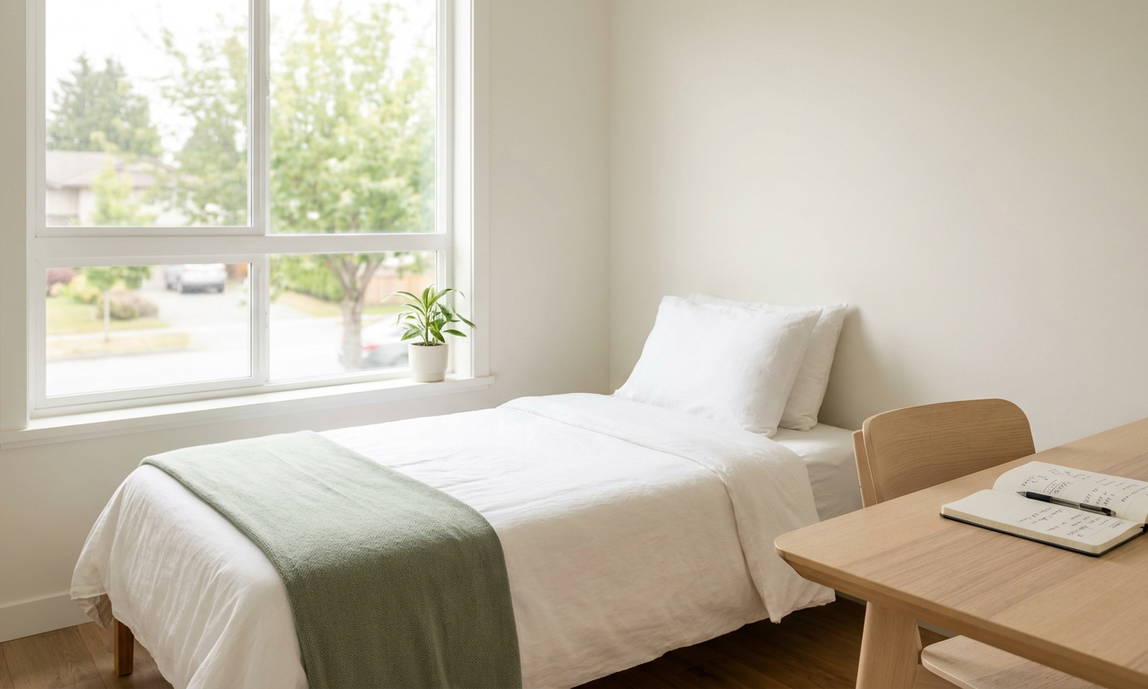
The first step is to furnish the room in an attractive and functional way. A comfortable bed, a workspace including a desk and an ergonomic chair, as well as adequate storage are the strict minimum to attract serious profiles. Don't forget that even if you share your home, the tenant needs privacy. Ensure that the room has a door that locks and a high-performance Wi-Fi connection, a criterion that has become non-negotiable today.
Then, the key to harmonious cohabitation lies in communication and establishing clear house rules from day one. As mentioned previously, the roommate agreement is your best ally. Openly discuss expectations regarding cleaning common areas, quiet hours, use of the kitchen, and guest policies. The more these aspects are clarified beforehand, the less risk there will be of conflict during the rental year.
Finally, beyond the purely financial aspect and the hedge against inflation, renting out a room in your home is also a wonderful human adventure. It is a unique opportunity to build social bonds, discover new cultures (particularly when hosting international students), and bring life back to a large home that may sometimes be too quiet. At Roomlala, we are proud to support thousands of hosts who have made this wise choice, transforming an economic constraint into a real opportunity for sharing.




There are no comments yet.
Add a comment
You must log in to post a comment.